Sapporo Area Map
- Hotel PoleStar Sapporo
(31st May, Sunday: Welcome Reception) - Sapporo Grand Hotel
(4th June, Thursday: Banquet) - JR Sapporo Station
Note: See the conference schedule
> https://iclp2026.org/programme.html




Venue

Kaderu 2.7(かでる2・7)
〒060-0002
Hokkaido
Citizens' Activity Center Building, Kita 2-jo Nishi 7-chome, Chuo-ku, Sapporo
Telephone number: 011-204-5100 (dial-in)
Fax: 011-271-9827
Note: See the conference schedule
> https://iclp2026.org/programme.html
Access from the nearest transportation
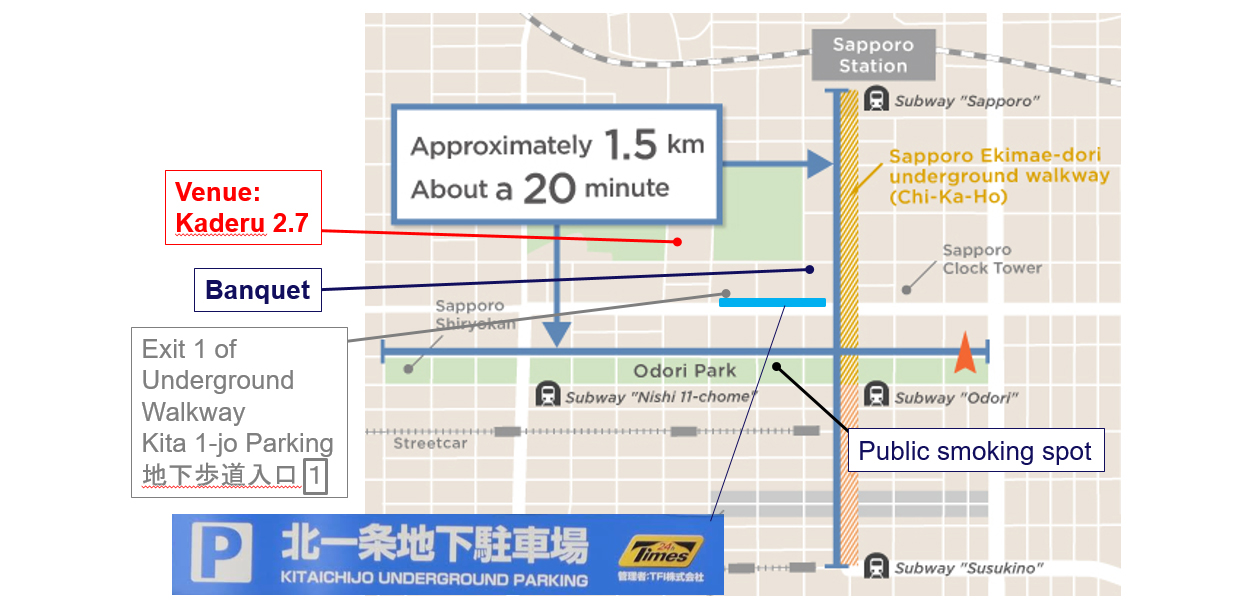
There are many hotels in the Sapporo city area, and you can arrange accommodation by yourself and the sooner you will book the cheaper the accommodation cost.
For your convenience, we prepare a block of rooms at selected hotels, and a hyper-link to the travel agent (JTB)’s site is provided as follows.
For smokers:
We kindly inform smokers that smoking is prohibited in public areas in Sapporo, including on roads and at the conference venue Kaderu 2.7 (which is operated by the city, and has no designated smoking area officially).
In addition, only a few hotels allow smoking in guest rooms, and this prohibit-tendency is stronger among higher-priced hotels. Please make sure to check when booking a room. Some hotels have smoking booths on the ground floor.
As of the summer of 2025 , for example,
Note: Please wear casual clothes, as smoke from the BBQ may cling to your clothing.
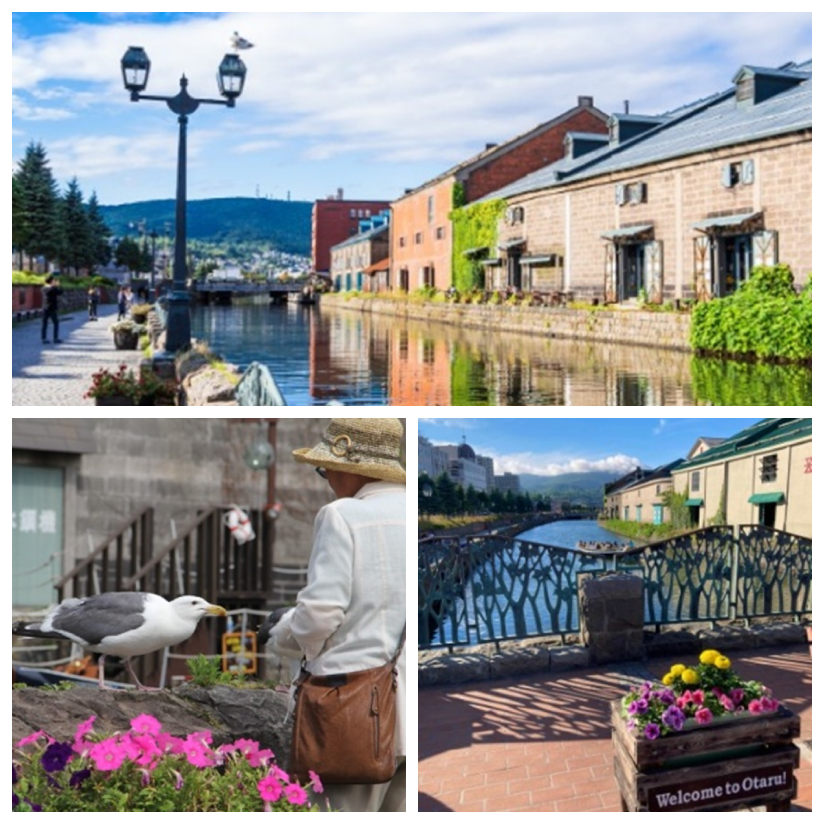
Completed in 1923, the Otaru Canal was once the strategic heart of Northern Japan’s international trade. During its golden era, it served as a vital hub connecting Hokkaido with Russia and the rest of Japan. This bustling waterway was the final destination for the legendary Kitamaebune cargo ships, which brought a wealth of goods from across the archipelago-from essential grains to the prized Hidaka Kelp "Kombu". While the world now knows "Kombucha" as a trendy fermented tea, this sea-harvested kelp was a true cornerstone of the region's culinary and economic prosperity.
Beyond maritime trade, Otaru’s wealth was fueled by the booming herring industry and its role as a major terminal for coal exports, which powered Japan’s industrialization. This immense prosperity gave rise to the iconic timber-framed stone warehouses that line the canal. These structures were meticulously engineered to endure Otaru’s brutal winters, where temperatures often plunge below -10°C (14°F). This unique architecture provided vital insulation, protecting precious cargo from the freezing elements while creating a rugged, enduring aesthetic that remains the soul of the city.
Today, these historic buildings have been carefully preserved and are now used as restaurants, cafés, and souvenir shops, allowing visitors to enjoy the canal’s rich history and nostalgic atmosphere.
Today, these historic buildings have been carefully preserved and are now used as restaurants, cafés, and souvenir shops, allowing visitors to enjoy the canal’s rich history and nostalgic atmosphere.
Otaru Canal (spot ①)
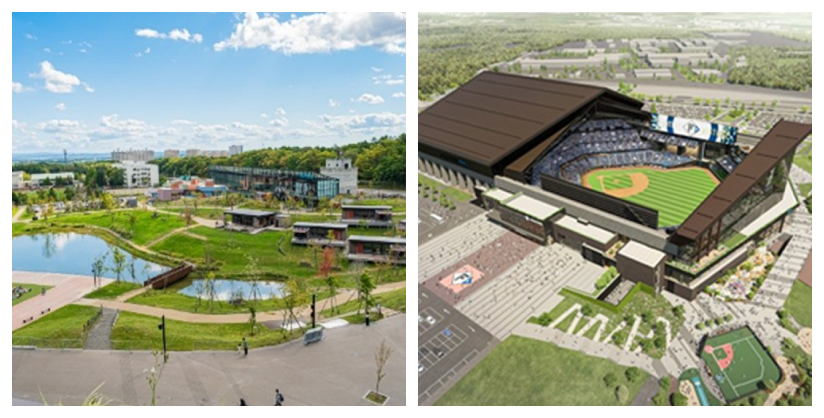
ES CON FIELD HOKKAIDO is a brand-new American-style ballpark and entertainment district that opened in 2023, featuring restaurants, shops, and a unique open-roof stadium. This park is not only a baseball stadium but also a spacious park open to everyone. Surrounded by green areas and walkways, it allows visitors to enjoy baseball games, relax outdoors, and spend quality time with family and friends, creating a ballpark that blends sports, nature, and daily life.
Note: There will be no baseball game on the day of the tour.
ES CON FIELD HOKKAIDO (Baseball park) (spot ②).
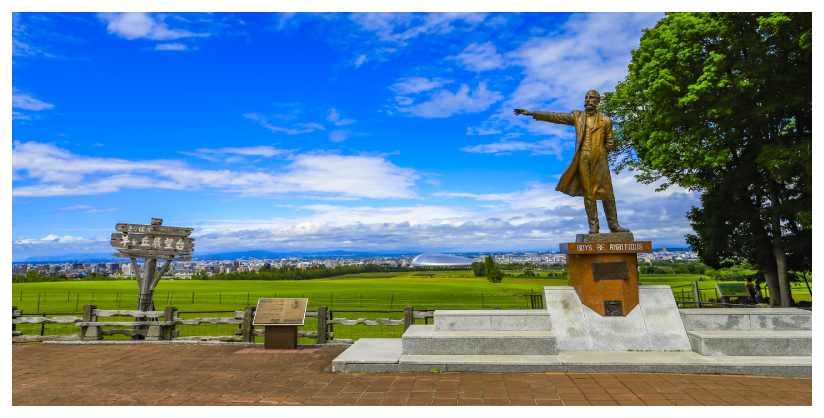
Hitsujigaoka observatory is a well-known scenic spot in Sapporo, famous for its peaceful pastureland and the statue of Dr. William S. Clark, an iconic symbol of Sapporo. Clark inspired young Japanese students while introducing Western-style higher education in the early Meiji period (1870s). He is widely known in Japan for his famous phrase, “Boys, be ambitious!”, which is often quoted in its original English. Visitors can enjoy a relaxed atmosphere with grazing sheep, seasonal flowers, and panoramic views over the Sapporo cityscape below. The observatory reflects the pioneer spirit of Hokkaido and offers a calm escape from the city, making it a popular destination for sightseeing and cultural exploration throughout the year.
Hitsujigaoka Observatory (spot ③).
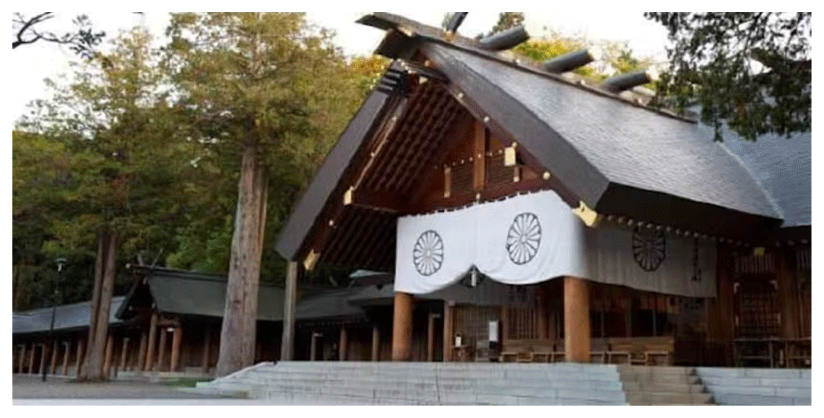
Hokkaido shrine was established in 1871 and is the most important Shinto shrine in Sapporo. Shinto is Japan’s indigenous national religion, and shrines are sacred sites dedicated to nature spirits known as kami. Visitors can observe traditional Japanese wooden shrine architecture and enjoy the calm atmosphere of a forested shrine area even in the middle of the city.
Note: Visitors are welcome to observe the shrine and its surroundings as a cultural site. Participation in religious practices is entirely optional.
Hokkaido Shrine (spot ④).
Okurayama Ski Jump Stadium is a historic ski jump venue in Japan, best known for hosting the ski jumping events of the 1972 Sapporo Winter Olympics. The stadium continues to host major ski jumping competitions, including World Cup events. and winter sports heritage.
Okurayama Ski Jump Hill (spot ⑤).
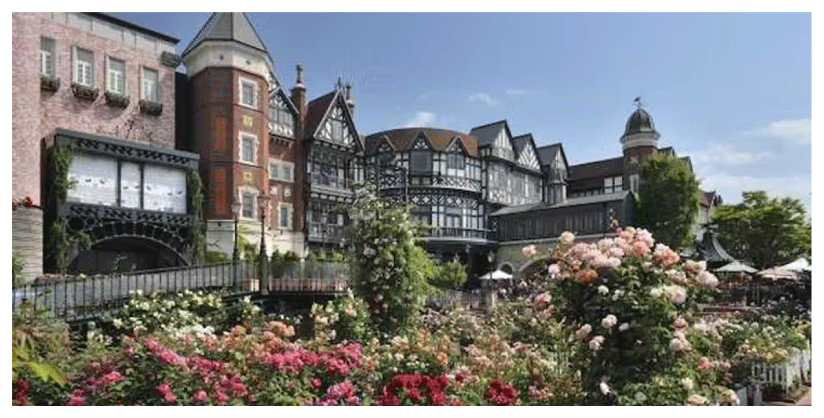
In addition to observing the chocolate production line, you can enjoy the Sweets Making Workshop, where you can make a heart-shaped Shiroi Koibito (about 14 cm) and relax at the Chocolate Lounge.
Shiroi Koibito Park (White chocolate factory) (spot ⑥).
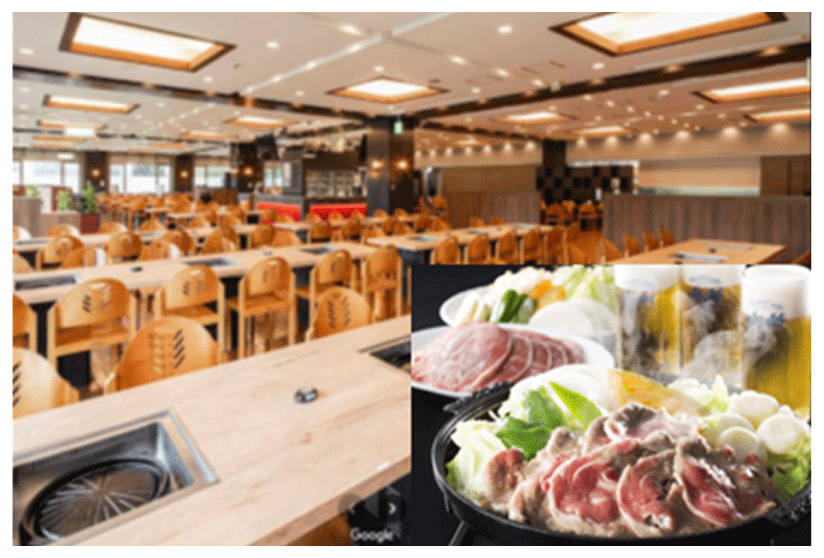
Genghis-Khan BBQ is a dish in which mutton or lamb is grilled together with vegetables on a special dome-shaped grill. The unique shape allows the meat juices to soak into the vegetables, making them even more delicious to eat.
Note: Please wear casual clothes, as smoke from the BBQ may cling to your clothing.
Asahi Beer Garden (spot ⑦)
The following information may be useful for your stay in Japan.
We hope these notes on local customs and practical matters will be helpful.
International-to-domestic connection after entering Japan
Immigration (*) Baggage Claim Customs declaration (*) Domestic Flight Check-in & Baggage Drop
Do not follow “Transit” or “Transfer” signs before immigration.
They are for international-to-international connections only.
Collect your checked baggage at your first airport in Japan.
Please register on the Visit Japan Web website in advance and obtain your QR code for smoother arrival procedures.
Paper-form counters may be limited at the airport.
This is an electronic registration, not an application for prior approval.
Your entry into Japan is not pre-screened or approved in advance through this system.
Visit Japan Web
https://www.vjw.digital.go.jp/main/#/vjwplo001
(Japanese government restrictions, in accordance with ICAO requirements)
Types:
| Power bank 1 | Power bank 2 | Spare batteries <= 100 Wh |
Spare batteries > 100 Wh and <= 160 Wh |
|
|---|---|---|---|---|
| <= 100 Wh | <= 100 Wh | No limit | Up to 2 | |
| > 100 Wh and <= 160 Wh |
> 100 Wh and <= 160 Wh |
No limit | Not allowed | |
| <= 100 Wh | > 100 Wh and <= 160 Wh |
No limit | Up to 1 |
Although both airports serve the Tokyo area, Narita and Haneda are far apart.
If you need to transfer between them, please allow a large time margin for your connecting flight.
Airport buses are often delayed by traffic and may take more than 1 hour.
JR trains are recommended.
Any JR airport train is generally fine for Sapporo Station (about 40 minutes), even if several train types are shown.
There is no tipping culture in Japan.
Tipping is not customary, including at restaurants, hotels, and in taxis.
Quick guide
(Android users: Japanese mobile IC card apps do not work on most foreign Android phones. Get a physical IC card.)
Additional information
In early June, Sapporo is usually mild and comfortable, with an average temperature of around 17°C. Daytime highs are around 22°C, while nighttime lows are around 12°C.
Short-sleeved or light long-sleeved shirts are suitable, but a cardigan or light jacket is recommended for mornings and evenings.
Sapporo has no rainy season, but occasional rain is possible, so a folding umbrella may be useful.
During the same period, Tokyo and Kyoto are warmer and more humid than Sapporo, with more rainy or cloudy days.
In Tokyo, the average temperature is around 23°C, with highs around 27°C and lows around 18°C.
Short-sleeved or light long-sleeved shirts are usually sufficient, and nights are not as cool as in Sapporo. An umbrella is recommended.
Emergency Calls: Police 110 / Ambulance and Fire service 119